About this app
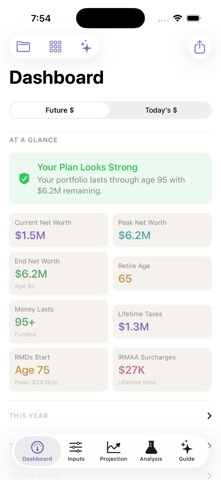
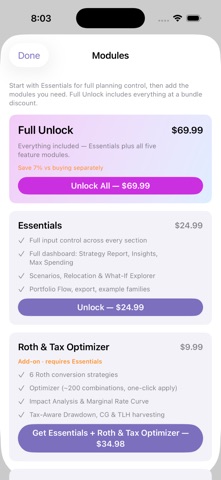
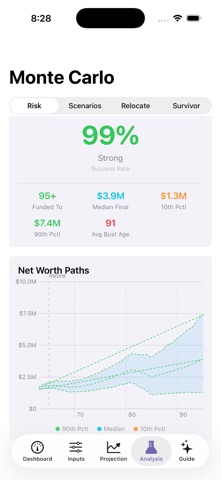
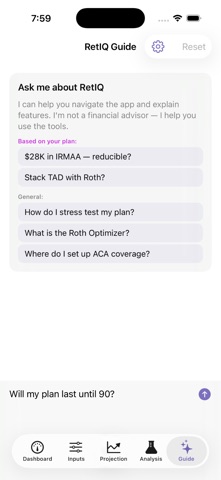
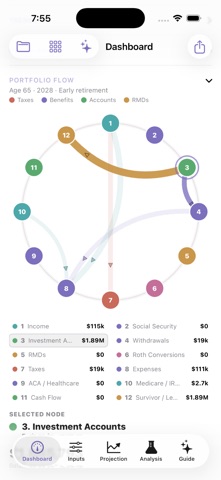
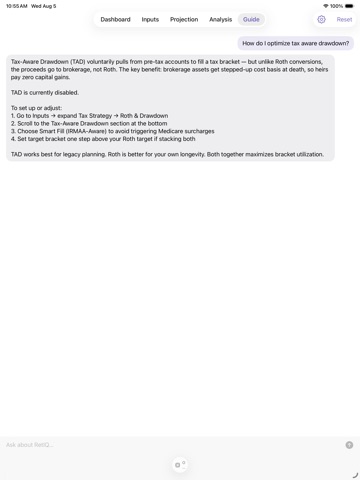
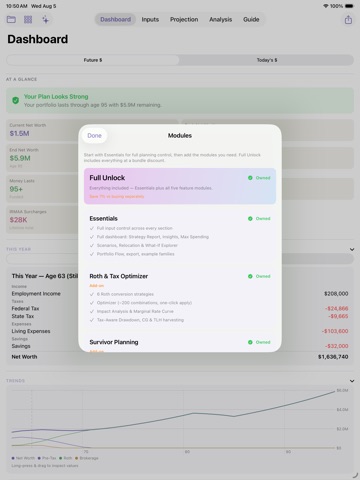
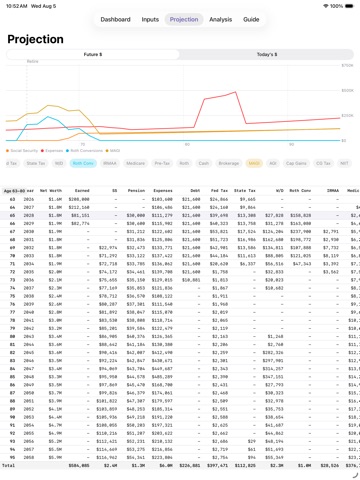
Retirement income is complicated. Social Security timing, Roth conversions, tax-aware drawdown, withdrawal order, taxes, Medicare costs, RMDs, and legacy goals all interact — and getting any one wrong affects everything else. RetIQ models all of it. Privately. Accurately. What RetIQ does RetIQ is a retirement decumulation planner for people who want to understand their finances — not hand them off. It answers the questions that matter most after you've saved: When should I claim Social Security? Should I convert to Roth before RMDs hit? Which accounts do I draw from, and in what order? How do Roth conversions affect my Medicare premiums? What happens financially if my spouse dies? What's my real probability of not running out of money? What makes it different Every calculation runs locally. Your financial data never leaves your phone — not during setup, planning, or ever. We cannot see your numbers because we never receive them. The AI Guide answers questions about your plan and is free on every tier. Use the built-in guidance, or optionally connect a cloud AI provider with your own key. Your key is never stored by RetIQ, and your plan never leaves your device. No subscription. No advisor required. Start free and buy only the modules you need — or unlock everything with a single purchase. All future updates are included. Modular pricing Start free with core planning, Monte Carlo, and the AI Guide. Add Essentials for full input control, the complete dashboard, scenarios, and relocation — now including Federal Employee and muni support. Then add specialist modules — Roth & Tax Optimizer, Survivor Planning, Healthcare & Medicare, Self-Employment & Business, and Legacy & Estate — each available separately, or unlock everything with a single Full Unlock. Pay once for what you use. What it models — Tax-Aware Drawdown: fill low tax brackets before RMDs hit, with proceeds reinvested in brokerage at full cost basis — Roth conversion optimizer: hundreds of strategies ranked by lifetime taxes saved — Strategy Report: 10+ alternatives auto-tested and ranked by your goal — Social Security timing from 62 to 70, spousal and survivor benefits, breakeven analysis — Survivor Center: model either spouse's death with filing status change, survivor SS, pension payouts, and life insurance — Federal Employee (FERS / CSRS) setup: annuity, the Special Retirement Supplement bridge to 62, survivor elections, and taxable percentage, with government-pension state treatment — Municipal bond (tax-exempt) interest: free of federal income tax and NIIT, still counted toward Social Security taxation, Medicare IRMAA, and ACA, with per-state and relocation-aware treatment — Multi-account withdrawal system: pre-tax, Roth, brokerage, cash/HYS, HSA, inherited IRAs, and annuities — Medicare and IRMAA surcharge modeling (Roth conversions and drawdowns affect your premiums) — Monte Carlo simulation with normal and bear-market stress paths — Required Minimum Distributions with SECURE 2.0 rules — Scenarios: 10+ named scenarios including Retire at 40 and Retire at 50, plus allocation-aware bear market stress test — ACA subsidy modeling for pre-Medicare retirees — Progressive state income tax — all 50 states + DC — Pension and annuity income with survivor benefit options — Long-term care costs and insurance modeling — Life insurance with term/permanent policies and tax-free death benefits — Income events, income streams, and one-time expenses — PDF report export from Dashboard — Automated tests verified against IRS, SSA, and CMS sources Verified accuracy Tax brackets, Medicare premiums, contribution limits, and Social Security parameters are sourced from IRS publications, SSA actuarial tables, and CMS Medicare data. An embedded Validation tab shows every test, expected value, and source citation, so you can verify the math yourself. RetIQ is a planning tool, not financial advice. All calculations run locally on your device.
Latest release
What’s New
Model Gradual-Release Annuities (TIAA Traditional & Similar) - RetIQ now models retirement plans whose money comes out over several years instead of all at once — most prominently TIAA Traditional, the classic "9 years and 1 day" contract (10 annual installments over a 9-year span, first payment immediate). - Add a Gradual-Release Annuity account on the Accounts tab: enter the carrier rate (the guaranteed base plus dividend your contract pays, not a market return), the number of installments, when the first release happens, and where each annual release should go — roll to your IRA tax-free, convert to Roth, spend, or move to brokerage. - The locked balance is correctly not treated as a lump-sum rollover: it is excluded from withdrawals and Roth conversions until released, its share of required minimum distributions is satisfied from the contract itself, and it is exempt from Monte Carlo volatility (a guaranteed contract is your fixed-rate leg). - Rollover destinations are limited to schedules under 10 years per IRC §402(c)(4)(A), and the app warns if you enter a schedule that wouldn't qualify. The same model covers stable-value funds, multi-year guaranteed annuities, and other contracts with staged access. - Improved handling of interest income: municipal-bond and cash-interest income is now treated as income available for spending in your projection, so plans holding munis or cash keep that money invested instead of withdrawing extra principal. If your plan includes these holdings, your projected ending net worth and available spending may be higher — that is the corrected number.
Audience growth
Ratings growth
Baseline captured. Growth appears after the crawler observes a changed rating count.
Momentum comes from crawler snapshots for the tracked storefront. “Viral growth signal” means unusually fast recent rating gains; it is an indicator, not download data.
Price tracking
Price intelligence
First snapshot captured. The trend line starts after the next crawler price observation.
- First observed Aug 19, 2026 · 4:21 PM Free
Screenshots