About this app
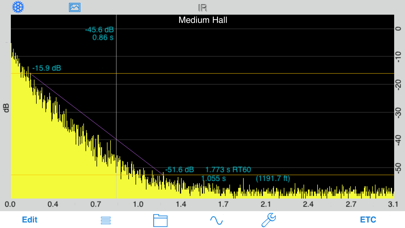
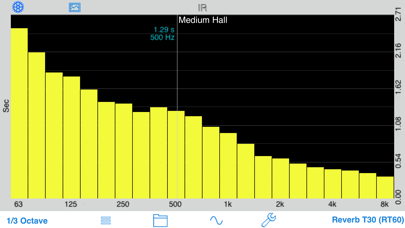
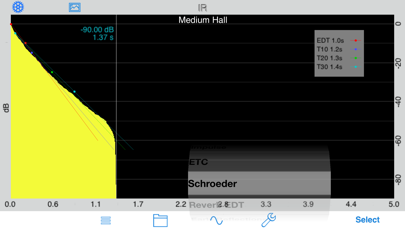
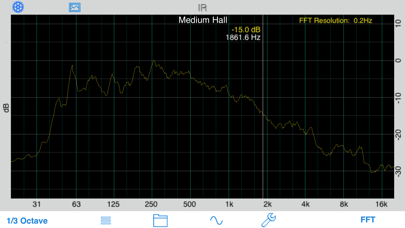
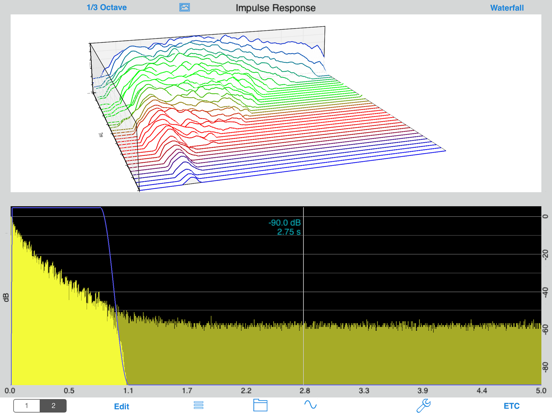
Room Impulse Response measures audio characteristics of a room or loudspeaker. Start by recording an impulse, such as a handclap or balloon pop, or record a swept sine and use the built-in deconvolution to create your Impulse Response (IR). Now, view the ETC, with RT60 decay cursors, apply windowing if you wish, or trim the IR. Next, see these other graphs: ** Impulse, where you can play back the actual IR ** ETC, which includes cursors to read out RT60 times directly, and allows pinch-zoom gesture for trimming the file. Apple a window, and see the effects of the window on the ETC plot. ** Schroeder curve, with EDT, T10, T20, and T30 markers And then see these charts, all in either in Octave or 1/3 Octave bands: ** T20 or T30 (RT60) times ** Reverb Early Decay Times (EDT) ** Clarity C50 ** Clarity C80 ** CT times ** Definition ** Signal / Noise And then you can also do spectral analysis, using our FFT, which can be windowed, for analyzing loudspeaker response without reflections, or see the 3D waterfall plot to view the decay of sound in the room by frequency, over time. Works great with the internal iOS device microphone, or attach or iTestMic or iAudioInterface2 for fully professional results. See the other great apps by Studio Six Digital, including AudioTools.
Latest release
What’s New
-Fixed a possible crash on launch
Audience growth
Ratings growth
Baseline captured. Growth appears after the crawler observes a changed rating count.
Momentum comes from crawler snapshots for the tracked storefront. “Viral growth signal” means unusually fast recent rating gains; it is an indicator, not download data.
Price tracking
Price intelligence
First snapshot captured. The trend line starts after the next crawler price observation.
- First observed Aug 16, 2026 · 1:53 PM $49.99
Screenshots