About this app
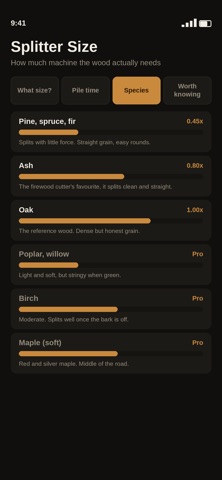
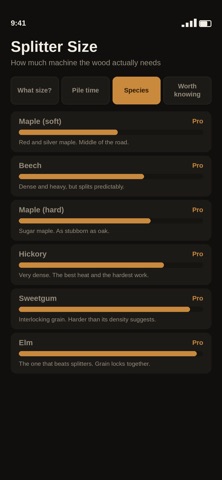
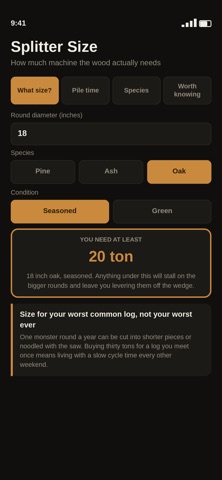
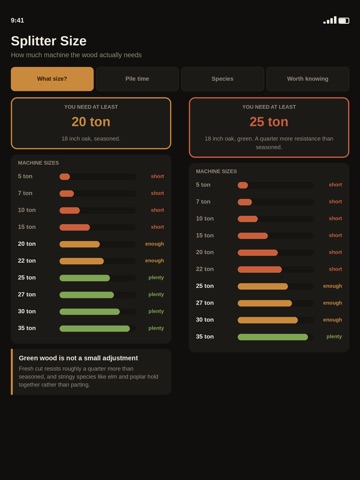
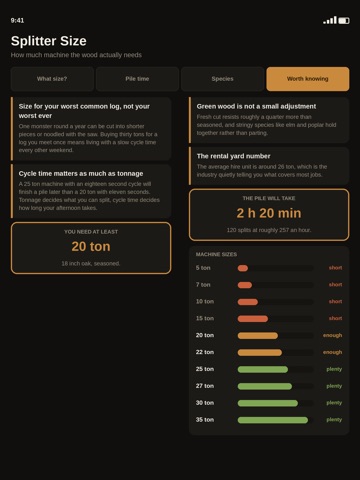
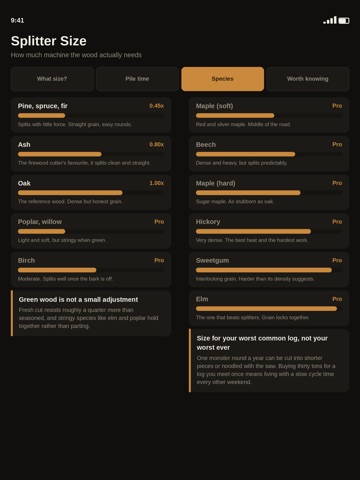
Splitter Size answers the question you ask once and now keeps the answer, so a season's worth of different wood does not mean the same sum over and over. KEEP YOUR WOOD Add each batch as it comes in: this winter's oak, the storm-down ash, the small offcuts. Every batch keeps its own diameter, species and condition, filed against the machine size that covers it. Standing in front of a pile in October, you read your own note back instead of guessing which batch was which. A BAND, NOT A NUMBER Set the diameter, the species and the condition, and a band appears on a scale marked with the machine sizes people actually buy. The published guidance genuinely disagrees with itself, so a single confident number would be a lie. The band tells you the truth and names the machine that covers it. SPECIES IS MOST OF THE ANSWER Pine at six inches wants seven tons. Oak at sixteen wants twenty-five. Elm beats splitters rated well above its density, because the grain locks together rather than parting. SOME WOOD YOU SHOULD NOT SPLIT AT ALL Big, green and knotty goes past every consumer machine on the market. The app says so instead of inventing a number. WORKS OFFLINE No account, no signal. Anything you save against a batch stays on your device. Splitters cause serious crush injuries: never put a hand near the wedge, never let a second person steady the log, and read the manual before the first cut.
Latest release
What’s New
Refreshed screenshots and minor presentation improvements. No changes to how the app works.
Audience growth
Ratings growth
Baseline captured. Growth appears after the crawler observes a changed rating count.
Momentum comes from crawler snapshots for the tracked storefront. “Viral growth signal” means unusually fast recent rating gains; it is an indicator, not download data.
Price tracking
Price intelligence
First snapshot captured. The trend line starts after the next crawler price observation.
- First observed Oct 16, 2026 · 5:43 PM Free
Screenshots